Best Smartphone for Business 2026
Find the best smartphone for business with our expert guide. We compare top models on security, productivity, and ecosystem to help you make the right choice.
 Editorial
Picking the best smartphone for business comes down to a careful balance of security, battery life, and raw productivity power. For most, the decision lands between Apple's rock-solid iPhone series, known for its secure ecosystem, and Samsung's Galaxy Z Fold, a true multitasking powerhouse. The right choice for you boils down entirely to your day-to-day professional workflow.
How to Choose the Best Smartphone for Modern Business Needs
Choosing a business phone today is a strategic investment, not just a line item on an expense report. This device is your mobile office, your primary communication hub, and a critical tool for getting work done. With 91% of U.S. adults now owning a smartphone, these pocket-sized computers are absolutely central to how we work.
This guide is designed to cut through the marketing noise. We'll skip the spec sheets and focus on what really matters for professionals in the real world, helping you find a device that genuinely supports your productivity and security for the long haul.
Setting the Stage for a Smart Decision
The market essentially offers two distinct paths: traditional flagship phones and the newer, innovative foldable devices. Each has its own set of strengths and is built for very different work styles. Getting this first step right is key to finding the perfect fit.
| Device Type | Primary Strengths | Ideal User Profile |
|---|---|---|
| Traditional Flagship | Simplicity, deep ecosystem integration, pocket-friendly design, and proven durability. | The professional who needs a reliable, secure tool for core tasks—communication, light document work, and running specific apps. |
| Foldable Smartphone | Massive screen real estate, unmatched multitasking, and genuine tablet-like functionality. | The power user who constantly juggles multiple apps, reviews detailed spreadsheets, or wants to replace both a phone and a tablet with a single device. |
Core Pillars of a Business Smartphone
This guide will focus on the non-negotiables that define a truly great business phone. Instead of getting bogged down in jargon, we’ll look at the practical side of each feature. We'll be evaluating phones based on:
- Enterprise-Grade Security: How well does it protect sensitive company and client data from threats?
- All-Day Performance: Can the battery survive a demanding workday without you hunting for an outlet by 3 PM?
- Productivity and Multitasking: Does the phone’s design actually help you get more done on the go, or does it get in the way?
- Durability and Longevity: Is the device built to handle the bumps and scrapes of travel and daily use?
The goal is to find a device that doesn't just meet today's needs but can adapt to whatever comes next. For those leaning toward a foldable, this evaluation has to include specialized accessories that protect the investment and unlock its full potential.
It’s also smart to think beyond just the phone. Considering other essential tools for solopreneurs and small businesses can help create a more cohesive and efficient workflow. When your entire toolkit works together seamlessly, you're set up for success.
Defining Your Criteria for a Business Smartphone
Choosing the right smartphone for your work isn't like picking one for personal use. You need a clear framework that cuts through the consumer hype and zeroes in on what professionals actually need to get the job done. A systematic approach ensures your investment pays off in productivity and keeps your data safe. The trick is to break down your needs into a few non-negotiable pillars that reflect how you really work.
From hardcore security to sheer physical toughness, each of these criteria plays a critical role. Think of it as building a spec sheet for your mobile command center. By looking at each pillar, you'll get a crystal-clear picture of what you need, making your final decision less about guesswork and more about your specific workflow.
Enterprise-Grade Security
In a business context, security isn't just another feature—it's the absolute foundation. A single data breach from a mobile device can be catastrophic, making enterprise-grade security your first and most important checkpoint. This goes way beyond a simple passcode or fingerprint scan.
You should be looking for devices with dedicated security platforms built right into the hardware, like Samsung Knox. These systems create an encrypted, locked-down folder for sensitive business data, effectively building a digital wall between your work and personal life on the same phone. Also, make sure the phone supports modern biometric authentication, like reliable facial recognition and ultrasonic fingerprint sensors, for access that's both fast and secure.
A business smartphone has to be a digital fortress. Its ability to protect client information, proprietary documents, and sensitive communications is non-negotiable. Compromising on security is simply not an option.
All-Day Battery Performance
A dead phone is just a paperweight. For a busy professional, running out of juice mid-day can bring your productivity to a screeching halt. "All-day battery life" is a claim every brand makes, but what that actually means depends entirely on how you use your phone. A device that lasts all day for a light user might not even make it to lunch for a power user.
To get a real sense of performance, look for phones with a battery capacity of at least 4,500mAh and support for fast charging—think 25W or higher. Fast charging is your safety net, giving you hours of power from just a few minutes plugged in. It’s also worth checking for smart software optimizations that manage power consumption, as these can make a huge difference during long travel days or back-to-back meetings.
Display Quality and Form Factor
Your smartphone's screen is your window to your work. Its quality, size, and shape directly impact how productive you can be when you're not at your desk. If you're constantly reviewing documents, digging into spreadsheets, or editing presentations, a larger, high-resolution display is a must-have.
This is where the difference between traditional flagships and modern foldables really becomes clear.
- Traditional Phones: They offer fantastic portability with bright, crisp displays that are perfect for emails, calls, and most standard apps. Their smaller size makes them great for one-handed use.
- Foldable Phones: These devices give you a tablet-like canvas when you need it, completely changing the multitasking game. The ability to view two apps side-by-side without feeling cramped is a massive advantage for complex workflows.
But don't just stop at size. Pay attention to brightness levels for outdoor visibility, refresh rates for smooth scrolling, and color accuracy if your work involves any creative tasks.
Productivity and Software Features
The best hardware in the world doesn't mean much without smart software to back it up. A great business phone should offer features that actively make your workflow smoother. We're talking about an intuitive operating system, seamless multitasking, and built-in tools that actually help you get more done.
Take Samsung's DeX platform, for example. It lets you connect your phone to a monitor and use it like a desktop computer—an incredibly powerful tool for anyone who works on the go. When defining your criteria, consider the efficiency of communication features such as voice to text on Android devices, which can significantly boost productivity for business users. These seemingly small software perks add up, saving you valuable time throughout your day.
Durability and Connectivity
Finally, a business device needs to be tough enough to handle the realities of professional life. Always look for official durability ratings, like an IP68 rating for water and dust resistance, which is the current industry standard. The screen should be protected by the latest reinforced glass, like Gorilla Glass Armor, to fight off scratches and survive accidental drops.
For foldable phones, durability is even more critical. The hinge is the heart of the device and needs rock-solid engineering. If you choose a foldable, pairing it with a high-quality protective case that specifically guards that hinge is essential to ensure it lasts. Of course, you also need strong connectivity, including support for Wi-Fi 6E and the latest 5G bands, for reliable access to cloud services and video calls, no matter where work takes you.
Comparing The Top Business Smartphones Head-to-Head
Choosing the best smartphone for business isn't about brand loyalty anymore. It’s about a cold, hard look at the facts. The market is really a battleground between a few giants, and each one has a totally different idea of what mobile productivity should look like. Let's break down the main contenders—Apple’s iPhone, Samsung’s Galaxy S series, and the game-changing foldables like the Samsung Galaxy Z Fold and Google Pixel Fold—using the criteria that actually matter to professionals.
We're going to move past the spec sheets and talk about how these devices hold up in a real, demanding business setting. The goal here is a clear, no-nonsense breakdown, showing you exactly which workflows and professional needs each phone is built for.
This infographic nails the three pillars of a great business phone: security, battery, and durability. Get these three right, and you have a reliable tool.
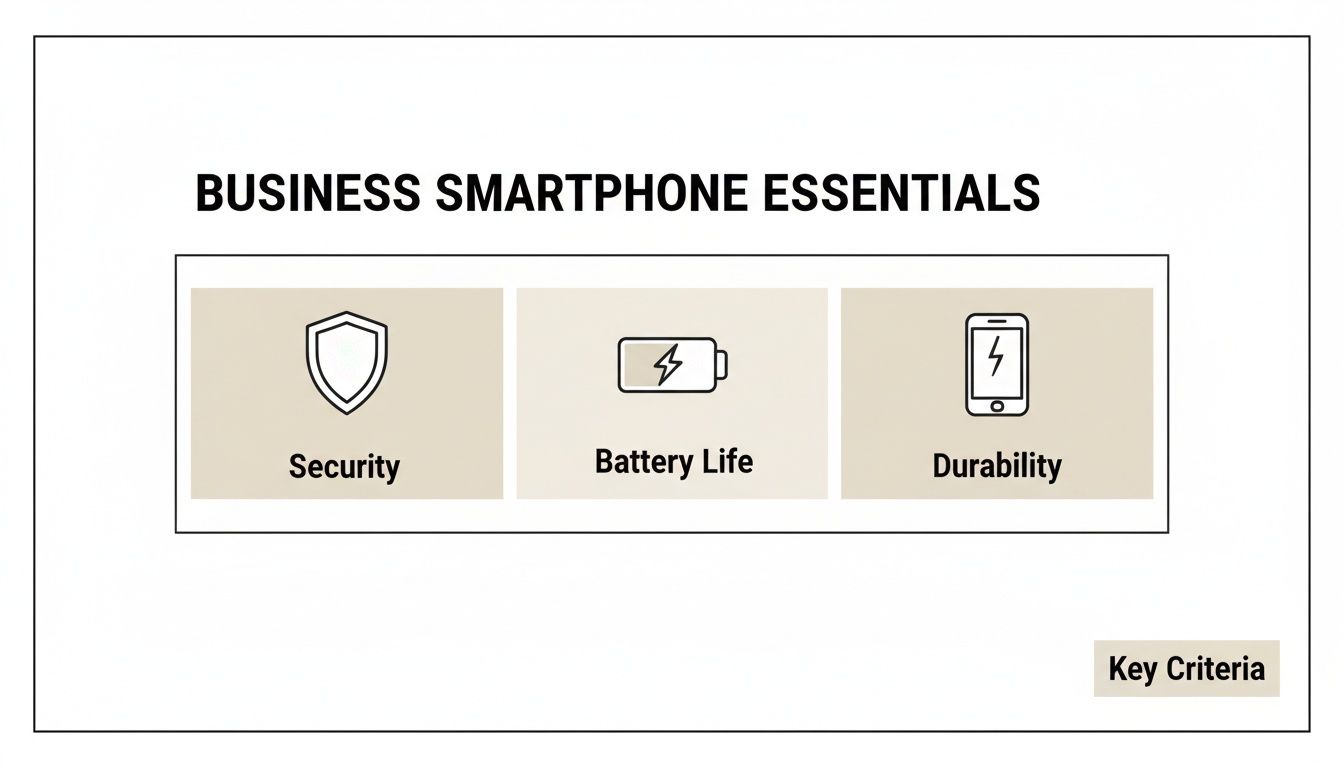
Without a solid foundation in these core areas, a device is just a gadget, not a professional workhorse.
Security and Ecosystem: The Walled Garden vs. The Open Fortress
When we talk security, it really boils down to the core philosophies of Apple's iOS and Google's Android. Apple's famous "walled garden" creates a tightly controlled and incredibly secure ecosystem. For any business where data integrity is everything—think legal, finance, or healthcare—the iPhone makes a powerful argument. Its closed system is just fundamentally harder for malware to penetrate.
On the flip side, you have platforms like Samsung Knox on Galaxy devices, which I like to call an "open fortress." It bakes enterprise-grade, hardware-level security right into the more flexible Android environment. This gives you way more customization and the freedom to sideload apps while keeping your sensitive data locked down in an encrypted container. For IT teams needing granular control, this hybrid approach is a dream.
Key Differentiator: The decision comes down to the iPhone’s simple, out-of-the-box security versus the powerful, customizable security frameworks on top-tier Android phones. Your industry’s compliance rules should be the tiebreaker.
Productivity and Multitasking: The Traditional vs. The Foldable
This is where the real fight is. Traditional flagships like the latest iPhone and Samsung Galaxy S are absolute masters of single-task efficiency. Their software is fine-tuned for lightning-fast actions—blasting out emails, juggling calendars, and running business apps without a hiccup. They are dependable, powerful, and slot right into the way most of us have worked for years.
But foldable phones like the Samsung Galaxy Z Fold and Google Pixel Fold were built for an entirely different kind of productivity. The moment you unfold that device, you have a tablet-sized screen that completely changes mobile multitasking. A sales pro can have a client's CRM profile open on one half of the screen while typing up a follow-up email on the other. An architect can review detailed plans without endlessly pinching and zooming.
This one feature fundamentally shifts what you can do on a mobile device, effectively giving you a phone's portability with a small tablet's power. To get a feel for how this plays out day-to-day, check out our in-depth review of the 2025 mobile office setup.
Battery Life and Durability: The Marathon Runners
All-day battery life is completely non-negotiable for a business phone. iPhones are legendary for their software optimization, which squeezes every last drop of juice from the battery. But Android flagships often hit back with physically larger batteries and blazing-fast charging. A 4,500mAh battery with 45W fast charging—pretty standard in high-end Androids—means a quick 15-minute plug-in can give you hours of power. That’s a lifesaver on a packed travel day.
Durability is another area with a clear trade-off. Traditional phones have top-tier IP ratings for water resistance and super-strong glass, making them incredibly tough. Foldables are more durable than ever, but they still have a mechanical hinge and a softer inner display that you have to be more mindful of. For anyone working in a rugged environment, a traditional device is probably the smarter bet—unless that foldable is wrapped in a serious, heavy-duty case.
Feature Comparison of Leading Business Smartphones
To really see these differences side-by-side, this table breaks down how the leading phones stack up across the most important business criteria. It’s a clear look at where traditional flagships shine and where foldables are creating a whole new category of productivity.
| Feature | Apple iPhone (Latest Model) | Samsung Galaxy S (Latest Model) | Samsung Galaxy Z Fold (Latest Model) | Google Pixel Fold |
|---|---|---|---|---|
| Security | Top-tier, closed ecosystem with excellent privacy controls. Simple and secure by default. | Robust with Samsung Knox, offering deep enterprise-level controls and hardware security. | Strong security (Knox/Titan M), but Android's open nature requires diligent IT management. | Secure with Google's Titan M chip, focused on a clean and safe Android experience. |
| Multitasking | Excellent for single-app focus. Split-screen is very limited and best for sequential tasks. | Strong split-screen and pop-up view features. Great for moderate multitasking. | Unmatched. A true tablet-like canvas for running multiple apps side-by-side. The ultimate mobile workhorse. | Excellent multitasking with a focus on seamless app pairs and a user-friendly taskbar. |
| Productivity | Seamless integration with Mac, iPad, and Apple Watch. A powerful, cohesive ecosystem. | Broad compatibility with Windows (Link to Windows) and a vast accessory market. Very flexible. | On-device productivity is the star. Merges phone and tablet workflows into a single device. | Leverages Google's software strengths for AI-driven productivity and smart features. |
| Durability | High IP ratings and strong screen glass. Proven resilience for daily professional use. | Similar high IP ratings and durable materials. A reliable choice for tough environments. | Improved, but the hinge and inner screen need care. A protective case is non-negotiable. | A solid first-gen build, but still requires more careful handling than a traditional phone. |
This comparison makes one thing crystal clear: Apple has solidified its position as the leader in the premium smartphone market, a key segment for professionals who need devices they can count on. In 2025, Apple took a commanding 20% share of the global market by shipping 248 million phones, a 6.3% jump from the previous year. Even more telling, Apple captured an incredible 62% market share for phones priced over $600, making it the undisputed choice for premium business users.
The Foldable Advantage in a Professional Workflow
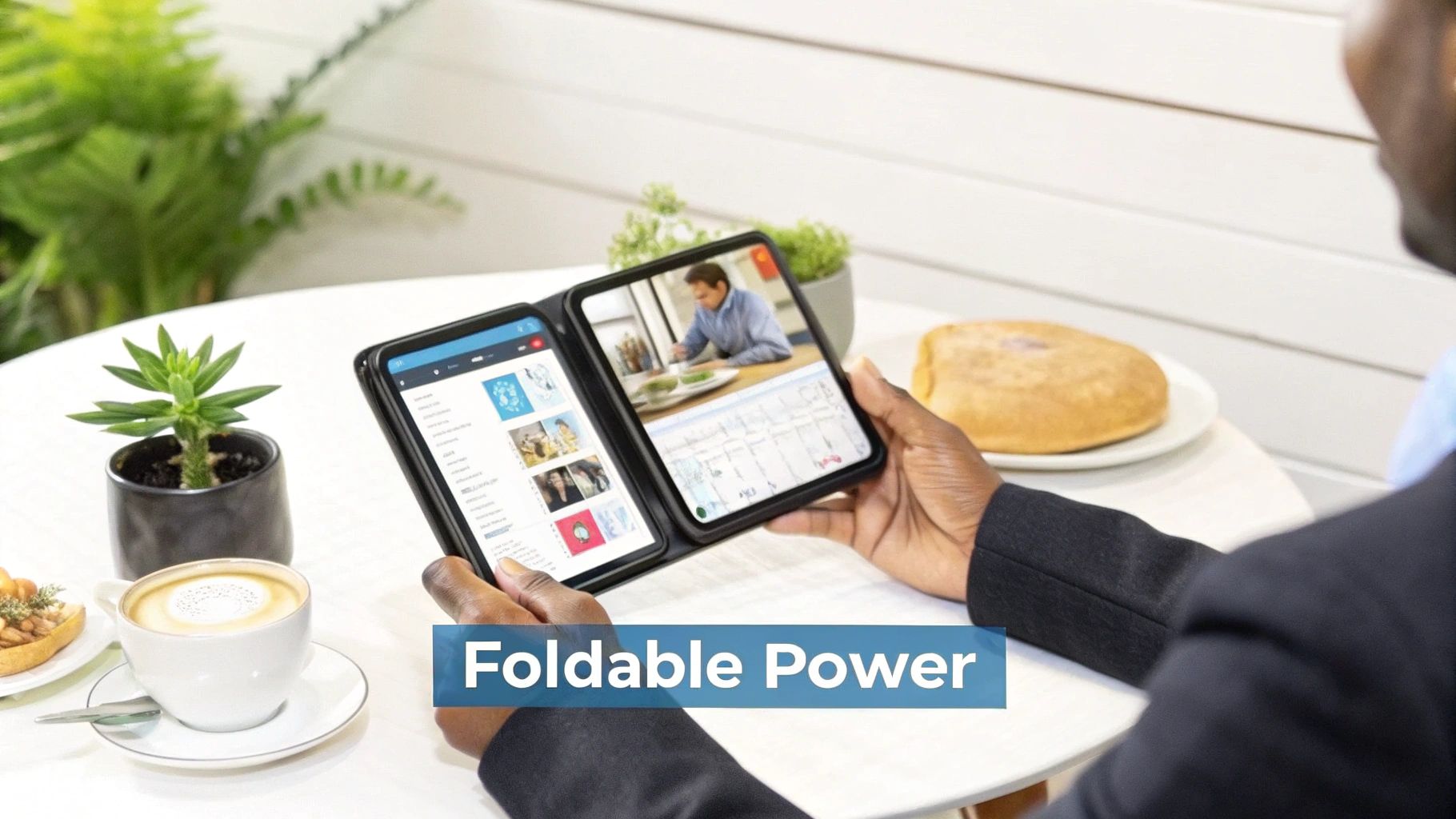
Standard smartphones are great at doing one thing at a time, but a new kind of device is completely rewriting the rules for mobile productivity. Foldable phones, which once felt like a novelty, have quickly become serious tools for business.
For anyone who needs to get real work done on the go, their ability to flip open from a normal phone into a mini-tablet is a huge advantage. It's a design that directly attacks the biggest weakness of a normal phone: its limited screen space. This isn't just about bigger text; it enables true, side-by-side multitasking that a regular screen can’t really handle.
From Screen to Workstation
The most obvious benefit of a foldable like the Samsung Galaxy Z Fold is just how much screen you get. This isn't just for show—it unlocks ways of working that you used to need a laptop for.
Think about a financial analyst looking at a complex spreadsheet on one half of the screen while writing an email about it on the other. No more flipping back and forth between apps. Or a project manager on a video call who can simultaneously pull up project notes and update timelines on the same device. These are practical, everyday scenarios where a foldable screen delivers a real boost.
The real value is simple: a foldable phone lets you carry less gear. It's one device that comfortably plays the part of both a high-end smartphone and a small tablet, cutting down on the tech you have to lug around.
This consolidation makes professionals more agile. For sales teams and logistics managers, being able to run maps and inventory apps right next to a client chat is a game-changer.
Unlocking New Levels of Mobile Efficiency
A bigger display also means better quality work. You can review detailed presentations, architectural plans, or high-res images with the clarity they deserve, ending that frustrating cycle of pinching and zooming. This is huge for creatives, engineers, and anyone who needs to see the fine print.
The software on these devices is built for this dual-screen setup. A handy taskbar lets you swap apps instantly, and you can even save "app pairs" to launch two programs you always use together with a single tap. You can learn more about how the latest foldables are pushing the boundaries in our deep dive on how the Pixel 9 Pro could change the foldable landscape.
Samsung has been at the forefront of this movement, and its mature foldable tech gives it a serious edge for business users. The Galaxy Z Fold and Flip series are still the ones to beat.
For today's power user, the benefits are undeniable. A foldable phone shifts the dynamic from just consuming content to actively creating and managing projects on the move, cementing its place as an essential tool for the future of work.
Protecting Your Investment with Essential Accessories
A high-end business smartphone is a serious investment. You're not just buying a phone; you're buying a critical piece of your workflow, and the price tag reflects that. With sensitive components and advanced tech, that investment demands real protection to keep it performing day in and day out.
For anyone using a foldable device, the stakes are even higher. The hinge and that gorgeous inner display are engineering marvels, but they're also uniquely vulnerable. The right accessories aren't just nice to have—they're what ensures your device survives the daily grind without a costly failure.
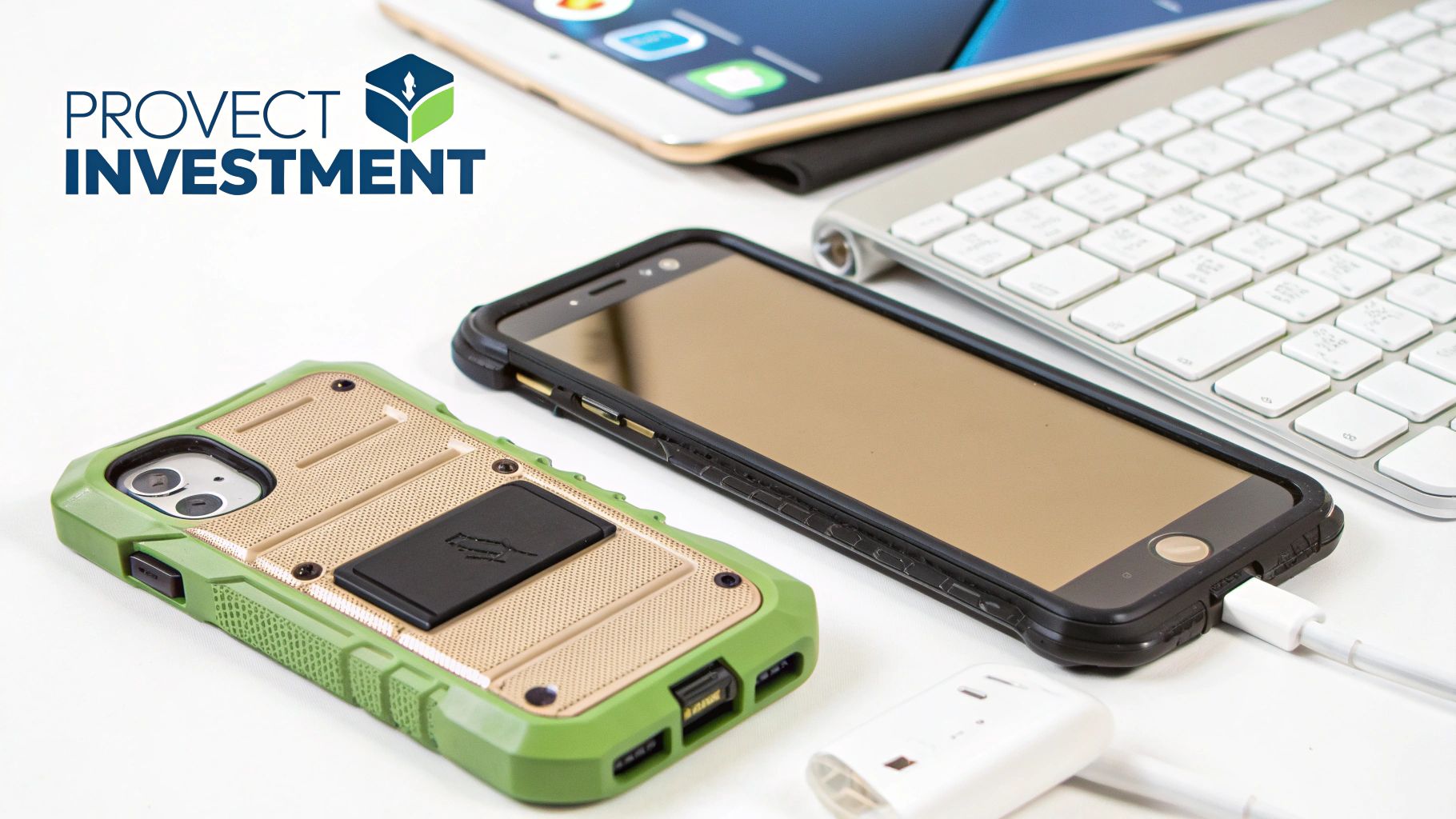
Hinge Protection: The First Line of Defense
A reinforced hinge cover is non-negotiable for a foldable. It’s designed to absorb shock right at the device's most fragile point. At FoldifyCase, our hinge protection uses military-grade drop-tested engineering to take the hit, so your phone doesn’t have to.
This is a game-changer for professionals in fieldwork, where bumps and drops are just part of the job. It also keeps dust and debris out of the mechanism, which is a common cause of that dreaded gritty feeling or a complete folding failure. A little protection here goes a long way.
Key Insight: The hinge is the single most delicate component on any foldable phone. Protecting it properly from the start is the best way to avoid expensive repairs down the road.
Rugged Cases for Demanding Fields
If your work takes you anywhere near a construction site, a warehouse, or the great outdoors, a standard case just won't cut it. You need something that can handle the elements. We're talking heavy-duty protection with sealed ports to keep out dust, water, and grime.
FoldifyCase offers rugged cases that meet MIL-STD-810G standards, featuring reinforced corners and shock-absorbing materials that laugh off impacts. Our magnetic aluminum and hybrid cases even support wireless charging, so you don't have to pry your phone out of its armor just to power up.
- Military-grade protection: Certified to withstand drops up to 6 feet and keep ports sealed from the elements.
- Magnetic modular design: Snap accessories on and off in seconds without a fuss.
- Reinforced frames: Built to shield the vulnerable edges and hinge area in high-stress situations.
And let’s not forget that inner screen. A high-quality tempered glass screen protector is essential to guard against scratches and cracks. The FoldifyCase ion glass option provides seamless, edge-to-edge adhesion that you’ll barely notice is there.
It maintains 99% of the screen's original touch sensitivity and color accuracy, so you get crystal-clear visuals for presentations without sacrificing protection.
Productivity Accessories That Transform Your Workflow
With the right gear, a foldable smartphone isn't just a phone—it's a full-blown mobile workstation. A keyboard case can instantly turn your device into a compact laptop, perfect for hammering out emails or editing documents between meetings.
Power management is another huge piece of the puzzle. A multi-device charger that can push up to 45W per port simplifies everything, letting you power up your phone, tablet, and earbuds all at once.
For a deeper dive into what’s possible, check out our guide on the top accessories for the Galaxy Z series. It covers everything from magnetic mounts to hinge guards. You can read it here: Top 7 Accessories for Galaxy Z Devices
A secure car mount is another must-have for anyone on the road. Magnetic dashboard mounts hold your foldable steady, giving you a hands-free view for navigation and calls during commutes or client visits.
FoldifyCase mounts are designed to work with vent clips or adhesive bases, so they fit practically any vehicle without getting in your way. That travel time between appointments suddenly becomes productive planning time.
A truly seamless mobile setup depends on having power and mounting solutions that just work. Juggling client calls, emails, and GPS navigation drains battery fast. Combining a 45W super-fast charger with a wireless charging station in your office and car means you’re always topped off and ready for whatever comes next.
Securing the Complete Setup
At the end of the day, robust protection and smart accessories are what turn a great phone into a reliable business tool. FoldifyCase accessories are designed to do more than just defend your device’s most fragile parts; they’re built to make your day-to-day work smoother and more efficient.
Whether you're managing a team in the field or presenting to clients over video calls, having the right case, screen protector, charger, and mount ensures your workflow is never interrupted. Investing in these essentials means fewer headaches, fewer repairs, and more time focused on what you do best.
- Protect the hinge: Use a dedicated hinge protector from FoldifyCase to prevent dust ingress and extend your phone's lifespan.
- Go rugged when needed: For travel or fieldwork, choose military-grade sealed cases to guard against water, dust, and drops.
- Shield the screen: Apply a tempered ion glass protector to keep the inner display flawless without losing touch sensitivity.
- Stay powered and productive: Equip your car and workspace with high-capacity chargers and mounts to keep things running smoothly.
How to Choose the Right Smartphone for Your Work
Picking the best smartphone for your professional life really boils down to an honest look at what your job demands. There’s no single "best" phone for everyone. The right choice is the one that fits perfectly into your workflow, industry, and daily grind without you even thinking about it.
That means you need to look past the spec sheets and think about practical, day-to-day use. Are you a road warrior who needs a phone that can handle being dropped or caught in the rain? Or are you an executive dealing with sensitive information who values the walled-garden security of a closed ecosystem? Your answer points you to completely different devices.
Find Your Professional Match
To make it simpler, think about which of these professional profiles sounds most like you. Each one prioritizes something different, from raw multitasking power to the elegant simplicity of a single ecosystem.
-
For the Power Multitasker: If you're a project manager in the field or a financial analyst juggling spreadsheets, client calls, and project apps, a foldable like the Samsung Galaxy Z Fold is unmatched. Its tablet-sized screen completely changes what you can do on the go.
-
For the Ecosystem Purist: An executive who lives and breathes Apple will get the most out of the latest iPhone. The seamless flow between a Mac, iPad, and iPhone, backed by top-tier security, creates a work environment with zero friction.
-
For the Mobile Creative: A content creator or architect who needs to review high-res images and plans away from their desk should also give foldables a serious look. The large, color-accurate display makes detailed work possible without having to lug around a laptop.
The Market is Leaning Toward Power
This laser focus on high-performance devices isn't just a niche trend; it’s reflected in the broader market. The global smartphone market is clearly shifting toward premium models and innovative foldables, with the top players tightening their grip. In 2025, shipments grew by a modest 2% to reach 1.25 billion units, but Apple and Samsung together captured nearly 40% of that entire market.
This consolidation proves that professionals are willing to invest in powerful flagship and foldable devices that deliver a real return. You can explore more about these global smartphone market trends and leader performance.
The takeaway is clear: the ideal business phone is a deeply personal choice tied to your role. But for the growing number of professionals investing in advanced foldable technology, robust protection isn't just an option—it's a mandatory part of the purchase to make sure that investment performs at its peak for years to come.
Frequently Asked Questions
When you're deciding on the best smartphone for your work, a few common questions always pop up. Here are some straightforward answers to help you navigate the choice.
Do I Really Need a Separate Phone for Business?
For most of us, the answer is no. A single, powerful smartphone is more than capable, as long as it has top-notch security. Platforms like Samsung Knox are a perfect example—they create a secure, encrypted "folder" on your device. Think of it as a digital wall separating your work life from your personal life, all on one phone.
Carrying a second device just becomes a hassle unless your company operates under incredibly strict compliance rules that demand a completely separate, locked-down phone. For everyone else, your personal high-end smartphone will do the job just fine.
How Tough Are Foldable Phones, Really?
Today's foldables are much more resilient than you might think, but they definitely need more careful handling than a standard phone. The two main weak spots are the hinge mechanism and the softer internal screen. Manufacturers have made huge strides with stronger materials and better dust resistance, but a foldable isn't built like a tank in the same way a solid slab phone is.
For any professional even thinking about a foldable, a high-quality case with dedicated hinge protection isn't just a good idea—it's non-negotiable. It's the one accessory that massively boosts the phone's chances of surviving drops and daily wear and tear.
Should My Business Go with iOS or Android?
This classic debate really boils down to two things: your existing tech ecosystem and how much flexibility you need.
- iOS (Apple): Known for its highly secure, closed-off ecosystem that’s incredibly simple to manage. If your team is already using MacBooks, iPads, and other Apple gear, the seamless integration makes iOS a no-brainer.
- Android (Samsung/Google): Offers far more flexibility, customization, and a much wider selection of devices, including powerful foldables. It’s the better choice for users who want more control over their software and hardware.
Both platforms provide robust, enterprise-grade security. The right choice really depends on what tech your company already uses and what your team needs to get their work done efficiently.
Ready to protect your professional foldable device? Find the perfect military-grade case and essential accessories at FoldifyCase and ensure your investment is built to last. Explore our collections at https://www.foldifycase.com.
Shop FoldifyCase foldable phone cases
Precision cases for Galaxy Z Fold & Z Flip — full MagSafe, S-Pen ready, zero bulk.